My workflow with AI
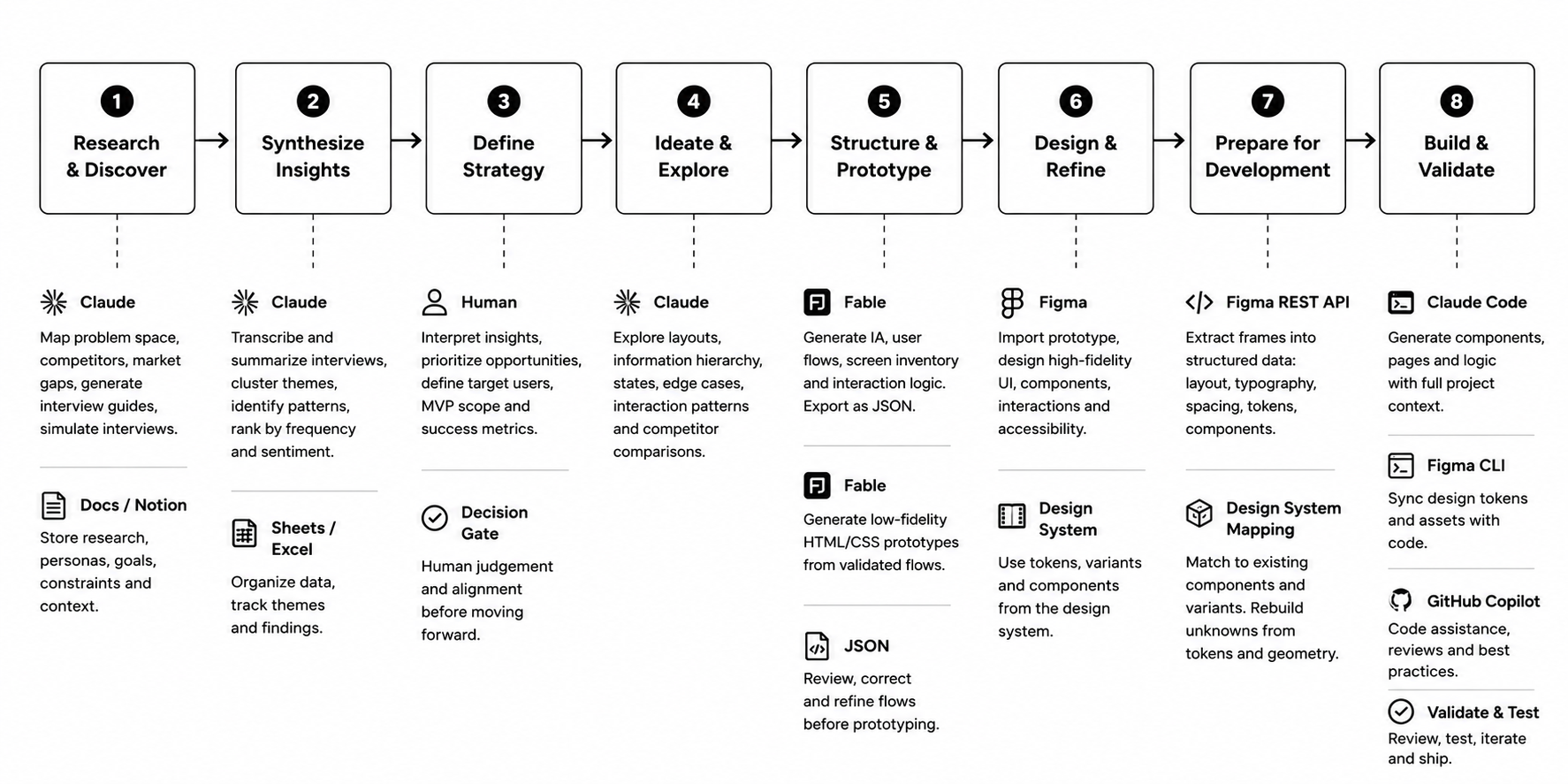
I start by building the context before asking any tool to generate output. I upload or document the product requirements, user research, personas, business goals, technical constraints, success metrics, conversations with engineering and product, and design system rules so the model is working from the same foundations as the team. The quality of the workflow depends less on clever prompting and more on the clarity of the documentation it receives.
During discovery, I use Claude to map the problem space. I ask it to identify common user challenges, then push further by asking where those assumptions came from and what evidence supports them. From there, I narrow the scope, compare relevant competitors and break down their strengths, weaknesses and product gaps. Claude can organise the landscape quickly, but it cannot decide which opportunity is worth pursuing. That remains a product decision.
I then use Claude to shape early research. It drafts provisional personas, generates interview scripts and simulates how target users might respond to those questions. I treat this as rehearsal rather than research—it helps me refine the questions before speaking to real users, but it does not replace real interviews or behavioural evidence.
After interviews, I upload transcripts and use Claude to summarise each conversation, identify recurring themes, cluster pain points and rank issues by frequency. This is where it provides the greatest value in research, reducing hours of manual synthesis into minutes. The clusters are a shortcut to patterns, not conclusions. Deciding which insights matter, which are noise and which should influence the roadmap still requires human judgement.
Once the direction is clear, I use Claude for structured ideation. I explore alternative layouts, information hierarchies, empty states, edge cases, filtering models and competitor approaches. The objective is not to generate the final interface, but to expand the solution space before making design decisions in Figma.
For larger product flows, I use Fable to extend this process into structure and prototyping. After uploading the validated product context, Fable generates information architecture, user flows, screen inventories and interaction logic. These outputs are exported as JSON, manually reviewed, simplified and corrected before being passed back into Fable to generate interactive low-fidelity prototypes in HTML and CSS. Fable accelerates production, while product logic remains a human responsibility.
As designs move towards implementation, reducing hallucination becomes more important than generating code quickly. Rather than asking Claude Code to interpret screenshots, I use the Figma REST API to extract structured design data including layout geometry, typography, spacing, variables, component relationships and design tokens. The interface is decomposed into logical regions and matched against the design system so known components can be recreated using their real variants and properties instead of being guessed.
I then use Halo OS to bridge the gap between design and implementation. AI coding tools often generate generic interfaces because they lack an understanding of a product's design system, inventing components, spacing, styling and tokens that don't exist. Halo OS provides coding agents with an AI-ready version of the design system, including design tokens, component metadata, reusable AI skills and structured project documentation. Rather than recreating interfaces from screenshots, models generate prototypes using real design system components, dramatically reducing hallucinations while producing faster, more consistent and production-ready outputs.
Finally, I use Claude Code, Figma CLI and GitHub Copilot to generate implementation-ready code, supported by documentation such as DESIGN.md, CLAUDE.md and design system metadata. In my experience, the limiting factor is rarely the model itself—it's the quality of the documentation and context it receives. Giving coding agents a shared understanding of the product, the design system and engineering conventions produces significantly more reliable results than prompting from scratch.
The design process itself has not changed. Research, strategy, prototyping, testing and iteration remain at the centre of product design. What has changed is the speed at which research can be synthesised, ideas explored, prototypes generated and implementations aligned with the design system. The tools handle repetitive work and execution, allowing me to spend more time where designers create the most value: understanding users, making product decisions and exercising judgement.